Canals & Concrete: 24 Hours in Kreuzberg
Kreuzberg’s identity is inextricably linked to its geopolitical history. Before 1989, it was enclosed by the Berlin Wall on three sides, creating an isolated pocket of West Berlin that attracted a distinct counter-culture. Confining a 24-hour adventure to this district exposes an urban landscape characterized by wide avenues, historical scars, and intensive waterfront usage.
Morning: The Scale of the Streets
Berlin is massive, and Kreuzberg reflects this sheer scale. The streets are exceptionally wide, a stark contrast to the narrow, winding historic centers of other European capitals. This vastness dictates movement.
- Infrastructure: Walking the length of major arteries like Oranienstraße or Skalitzer Straße reveals heavy reliance on cycling infrastructure. The wide sidewalks comfortably accommodate distinct lanes for pedestrians, cyclists, and sprawling café seating.
- Visual Texture: The architecture is a patchwork. Imposing 19th-century Mietskaserne (barracks-like tenement blocks) sit adjacent to blank lots and post-war concrete infill. Almost every accessible surface at ground level is heavily modified by street art and graffiti, functioning as an ongoing, chaotic visual dialogue.
The morning atmosphere is surprisingly subdued. Kreuzberg operates on a delayed schedule; commercial activity builds slowly, reflecting a neighborhood heavily oriented toward night-time economies.
Afternoon: The Canal System
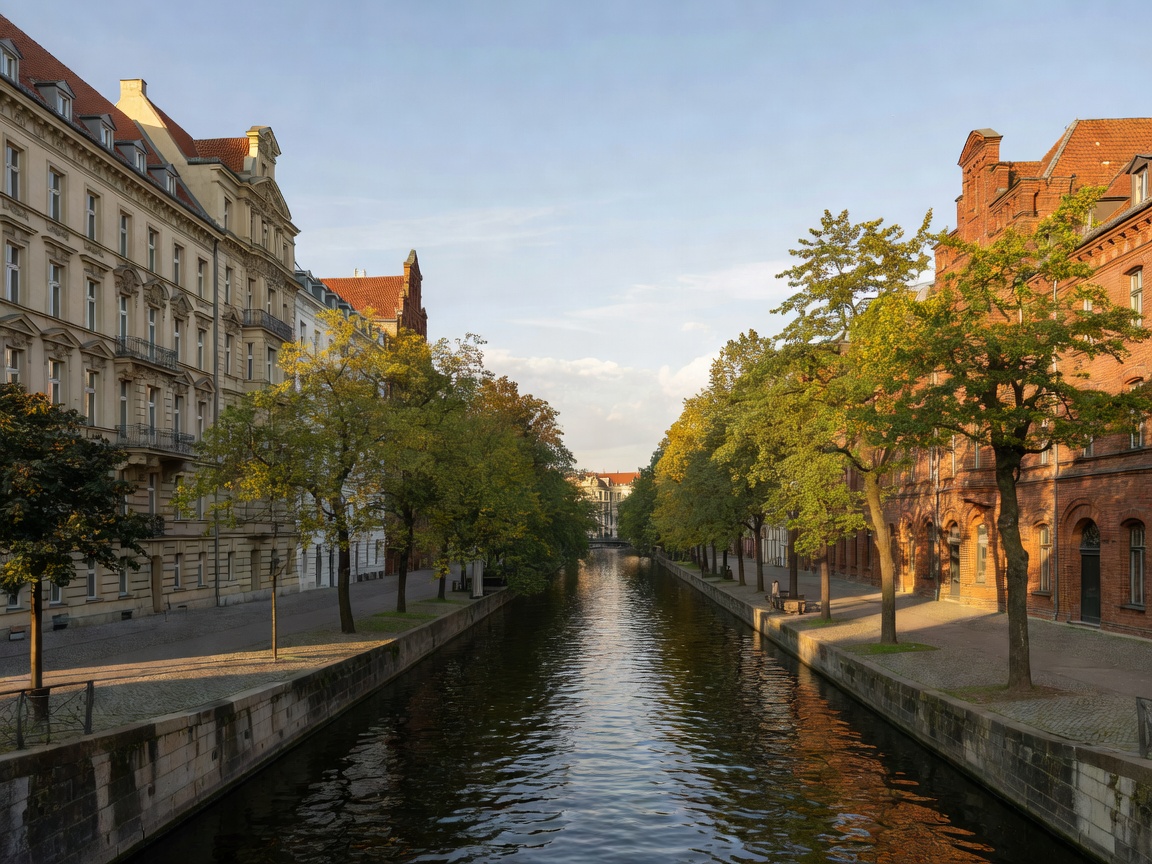
The Landwehr Canal bisects the district and fundamentally alters its urban dynamic. In the afternoon, focus shifts from the hard concrete of the wide streets to the softer, densely packed banks of the canal.
Public Space Usage: The grass banks along the Paul-Lincke-Ufer and Maybachufer function as extended public living spaces. The density of bodies sitting, eating, and interacting by the water stands in contrast to the rapid transit happening on the roads just meters away. It is an excellent location to observe the diverse demographics of the area, a mix of long-standing Turkish immigrant communities and transient international youth.
The Market Economy: If timed correctly, the Turkish Market along the canal provides a condensed view of local commerce, characterized by loud bartering, immense piles of produce, and street food stalls tightly packed against the water’s edge.
Evening: Industrial Repurposing
As evening falls, the neighborhood’s industrial past becomes its greatest asset. The vast interior spaces required by former factories and depots have been universally repurposed into cultural and nightlife venues.
Exploring Kreuzberg at night requires comfort with raw, unpolished environments. Many significant venues are hidden behind unmarked doors or situated in massive, decaying courtyards (Hinterhöfe).
- Spatial Disorientation: The scale of the Hinterhöfe means that entering an archway from the street can lead into a labyrinth of three or four interconnected courtyards, each hosting different businesses, from mechanics to underground clubs.
- Endurance: The 24-hour cycle here is literal. Nightlife does not conform to standard closing times, bleeding heavily into the following morning. Navigating the district during these twilight hours highlights the area’s absolute rejection of standard urban scheduling.
A Study in Patched Urbanism
A day spent exclusively in Kreuzberg is a study in friction. It is a neighborhood where historical trauma, rapid gentrification, and entrenched counter-cultures physically rub against each other. The wide streets prevent claustrophobia, but the intense visual noise and social density demand constant engagement. By staying within its borders, you avoid the sanitized tourist corridors of the center and confront the raw, functional mechanics of the city.